
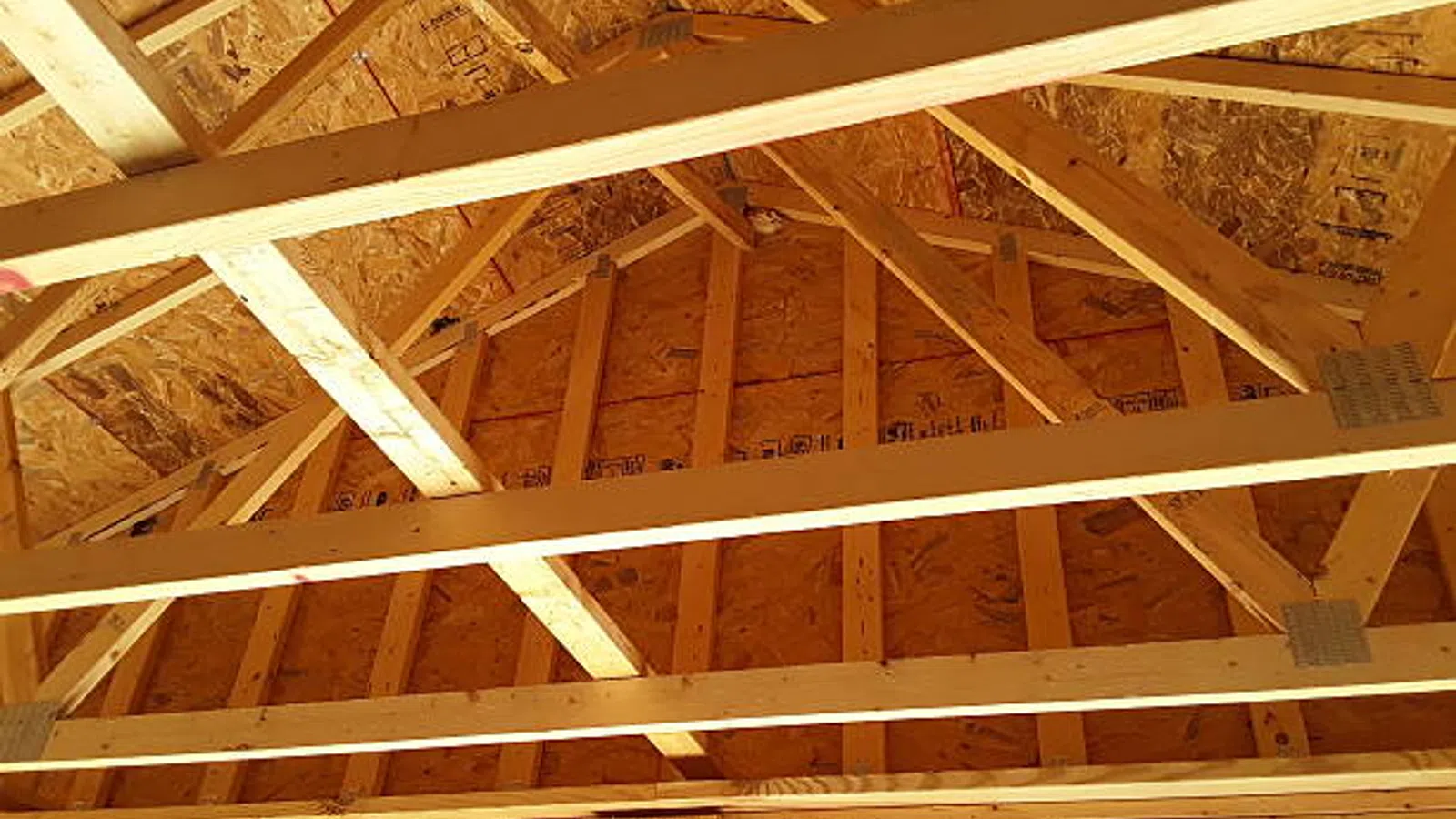
Vaulted and cathedral ceilings can make a room feel larger, brighter, and more open.
They can also make that room one of the hardest spaces in a Bowling Green home to keep comfortable.
Unlike a standard flat ceiling with a large attic above it, many vaulted ceilings have limited space between the interior drywall and the roof deck. That smaller cavity has to handle insulation, airflow, roof ventilation, wiring, and sometimes recessed fixtures all within a narrow assembly.
If the insulation is thin, uneven, compressed, or interrupted, the room below may feel too warm in summer and too cold in winter.
At USA Insulation, we look at how the entire ceiling and roof assembly is working rather than assuming every uncomfortable room has the same cause.
Why Vaulted Ceilings Behave Differently
A traditional attic gives builders more room to install insulation across a broad horizontal surface.
A cathedral ceiling follows the roofline.
That means the insulation typically sits inside sloped framing cavities between the finished ceiling and the roof.
The available depth may be limited by the size of the rafters or trusses.
If there is not enough space for the insulation level the home needs, or if the material was installed poorly, heat can move through the ceiling more easily.
The result may be a room that reacts quickly to outdoor temperature changes.
Summer Heat Can Be More Noticeable Near the Roofline
Bowling Green summers bring long periods of heat and humidity.
Roofing materials absorb solar heat throughout the day.
In a room with a vaulted ceiling, the occupied space sits much closer to that hot roof surface than it would beneath a full attic.
If insulation is inconsistent, heat can move downward into the room.
Homeowners may notice:
- The Room Is Comfortable In The Morning But
Hot By Late Afternoon
- The Ceiling Feels Warm
- Upstairs Spaces Stay Hot After Sunset
- The HVAC Runs Longer For One Part Of The
Home
- Ceiling Fans Are Used Constantly To Make The Room Feel Comfortable
These symptoms can be mistaken for an undersized air conditioner when the ceiling assembly is part of the problem.
Winter Can Expose the Same Insulation Gaps
During cold weather, the direction of heat flow changes.
Warm indoor air moves toward colder surfaces.
If the sloped ceiling has weak insulation coverage, the room may lose heat faster than nearby spaces.
A living room with a cathedral ceiling may feel chilly even when the thermostat reads normally.
Homeowners may compensate by raising the temperature for the entire house, which can make other rooms too warm.
That unevenness is often a clue that the building envelope deserves attention.
Compression Can Reduce Insulation Performance
Vaulted ceilings have limited cavity space.
That can lead to a common problem: insulation being squeezed into a cavity that is too shallow for the material.
Insulation works best when it is installed at the proper thickness and density for that product.
Compressing some insulation types can reduce their ability to slow heat transfer.
The problem is especially difficult to identify because the insulation is usually hidden behind finished drywall.
Homeowners may only notice the result through comfort differences.
Recessed Lights Can Interrupt the Ceiling Assembly
Vaulted ceilings often include recessed lighting.
Each fixture creates another interruption in the ceiling cavity.
Older fixtures may have been installed with clearances that limited how insulation could be placed around them.
Even newer installations can create weak points if the surrounding insulation is incomplete.
That does not mean every recessed light is a problem.
It does mean that ceiling penetrations should be considered when evaluating why one section of a room feels hotter or colder.
Ventilation Space Can Compete With Insulation Space
Some sloped roof assemblies are designed with ventilation channels between the insulation and roof deck.
Those channels help air move from lower roof vents toward upper exhaust points.
The challenge is that ventilation needs space, and insulation also needs space.
If the cavity is shallow, installers must balance both requirements without blocking airflow or leaving too little insulation.
Improper installation can create areas where the thermal barrier is thinner than expected.
This is one reason
cathedral ceilings should be evaluated as a system rather than by guessing from
the interior surface.
Why Some Rooms With Vaulted Ceilings Have Hot and Cold Zones
Large vaulted rooms often contain several roof slopes, corners, beams, and transitions.
Each of those changes can affect how insulation is installed.
A section near an exterior wall may perform differently from the middle of the ceiling.
The area around a skylight may be different from the section around a ceiling fan.
Where rooflines intersect, framing can create narrow spaces that are harder to insulate consistently.
That can produce
noticeable temperature zones within the same room.
Skylights Can Add Another Layer of Complexity
Skylights are common in rooms with vaulted ceilings because they bring natural light into the space.
They also create openings through the roof and ceiling assembly.
The shaft around the skylight must be insulated properly.
If insulation is missing or uneven around that shaft, homeowners may feel drafts or temperature differences near the opening.
The skylight itself may also transfer more heat than the surrounding insulated roof assembly.
Evaluating the entire area helps distinguish window-related heat transfer from insulation gaps around the framing.
Older Bowling Green Homes May Have Limited Ceiling Cavities
Many homes have been renovated over time.
A vaulted ceiling may have been part of the original design or added during a later remodel.
Older roof framing may not provide the same cavity depth that newer assemblies use.
Previous renovations may also have changed lighting, wiring, or ventilation.
That means two homes that look similar from the inside can have very different insulation conditions above the ceiling.
Age alone does not tell the whole story.
The construction method matters.
Signs a Vaulted Ceiling May Have an Insulation Problem
Homeowners may want to investigate further when they notice:
- One Large Room Is Harder To Heat Or Cool
- The Ceiling Feels Hot In Summer
- Cold Drafts Seem To Come From Above
- Temperature Changes Follow Sunny Weather
- Certain Ceiling Sections Feel Different From
Others
- The Room Becomes Uncomfortable Faster Than
Nearby Rooms
- Energy Use Seems High Despite Normal HVAC
Operation
- A Remodel Added Recessed Lights Or Skylights
- Ice Or Frost Patterns Appear Unevenly On The Roof During Cold Weather
These signs can have more than one cause.
A professional evaluation helps determine whether insulation is contributing to the problem.
Why Adding Attic Insulation Somewhere Else Will Not Fix a Vaulted Ceiling
A common misunderstanding is that all ceiling-related comfort problems can be solved by adding insulation to the main attic.
That only helps areas connected to that attic.
A cathedral ceiling may be a separate enclosed assembly.
If the weak point is inside the sloped roof cavity, adding material over a different flat ceiling will not address it.
The solution needs to match the actual construction of the room.
That is why identifying the boundary of the conditioned space is an important first step.
How an Insulation Evaluation Helps
An insulation evaluation can look at the room layout, ceiling type, roofline, accessible attic areas, visible penetrations, and comfort patterns.
The goal is to determine where the thermal boundary changes and whether there are likely weak points.
Depending on the home, the next step may involve improving insulation in accessible areas, addressing air leakage, or developing a more targeted plan for the sloped ceiling assembly.
Not every vaulted ceiling needs major work.
The important part is understanding the construction before choosing a solution.
Make Large Rooms More Comfortable in Every Season
Vaulted ceilings are meant to be a feature of the home, not a reason to avoid the room during extreme weather.
If your Bowling Green home has a cathedral ceiling, great room, bonus space, or addition that is consistently harder to heat and cool, insulation may be part of the reason.
USA Insulation can evaluate the home's insulation and help identify areas where the thermal barrier may be incomplete or underperforming.
Contact us to
schedule an insulation inspection for your Bowling Green home.