The Avista Utilities Home Insulation Program requires an itemized invoice and documented before and after R-values, filed by an approved installer. We measure your existing insulation, install to program standards, record the R-value improvement, and submit the documentation, so the rebate does not depend on you assembling paperwork correctly.
The part homeowners actually worry about
When people hesitate on a rebate, it is rarely because they doubt the money exists. It is because they have been through a rebate process before, and they remember the receipt they could not find, the form field they filled in wrong, and the check that never came.
That concern is reasonable. Utility rebates do have documentation requirements, and they are enforced. The difference here is who is responsible for meeting them.
What the program actually requires
The Avista Utilities Home Insulation Program is not complicated, but it is specific. For qualifying work on an existing home, the requirements come down to four things.
- An approved installer does the work. The program maintains a list of installers, and the rebate is built around work performed by one of them.
- The existing R-value is documented. Somebody has to record what was in your attic, wall, or floor before anything was added.
- The finished R-value is documented. And it has to clear the program threshold: attic from R-11 or less up to R-49 or more, walls from an empty cavity to R-11 or more.
- An itemized invoice is submitted. Not a lump-sum receipt. The invoice needs to show what was done, where, and to what specification.
Miss any one of those and the rebate is at risk, which is exactly why the measuring step at the beginning matters as much as the installing step in the middle.
How it works when we handle it
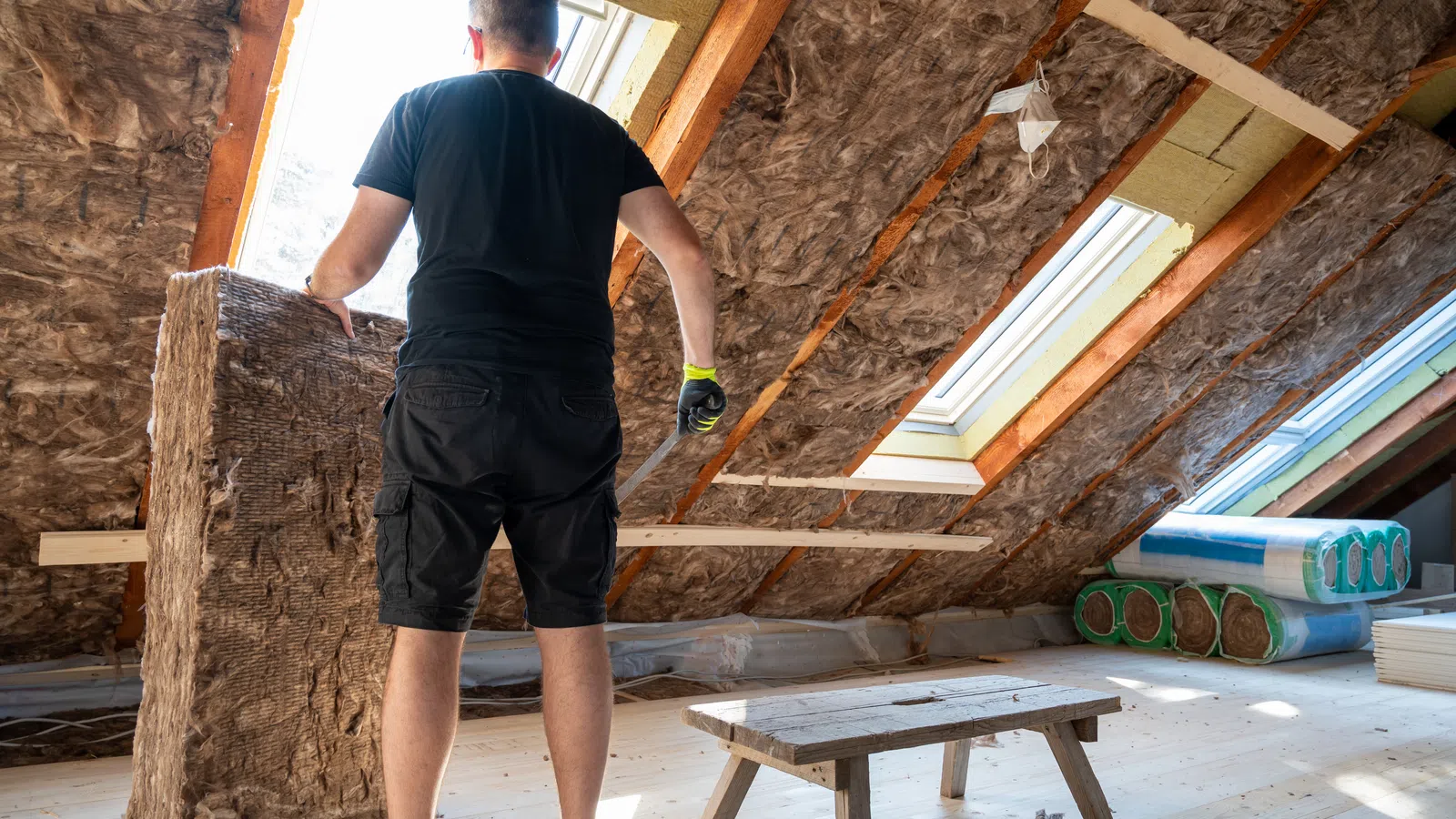
- We assess and measure. Someone goes into the attic and records actual depth and material in multiple spots, and checks whether your walls already have anything in them. That measurement is the baseline the whole rebate rests on.
- We confirm your eligibility. Which state you are in, how your home is heated, and whether the home qualifies as an existing primary residence. These determine both whether you qualify and how much you get.
- You get an itemized quote with the rebate accounted for. Not a number with a vague promise attached to it. You see the scope, the square footage, the target R-value, and the rebate line.
- We install to program standards. Including the air sealing that makes the insulation perform the way its rating says it should.
- We document the finished R-values. And mark the depth in the attic so it can be verified later, by us or by anyone else.
- We submit the documentation. The itemized invoice and the R-value certification go where they need to go.
What you are responsible for
Very little, but not nothing, and it is better to know upfront.
- Being an Avista Utilities residential customer. The account needs to be active at the address where the work is done.
- The home being your primary residence. Seasonal and vacation properties are outside the program.
- Access. Someone needs to let the crew into the attic and around the exterior.
- Keeping your copy. We give you the documentation. Put it somewhere you will find it, both for your records and for resale.
Washington and Idaho pay differently
This affects what shows up on your quote, so it is worth stating plainly rather than burying.
Measure |
Washington |
Idaho |
Attic, wall, floor insulation |
About $1.75 per sq ft |
About $1.00 per sq ft |
Duct insulation and sealing |
About $400 per home |
About $400 per home |
Eligible heating |
Electric or natural gas |
Electric heat only |
Income qualification |
None |
None |
A Spokane homeowner and a Coeur d'Alene homeowner doing identical work will see different rebate amounts, and an Idaho home heated with natural gas is not eligible for the insulation program at all. Rebate amounts and eligibility can change, so we confirm the current figures at www.myavista.com/getrebates before quoting rather than working from last year's numbers.
Why the measuring step is the one that fails
If a rebate is going to fall apart, this is usually where. The program pays on the improvement, not on the finished number alone, which means the before value has to exist and has to be credible.
A contractor who quotes from the driveway has no baseline. One who assumes a starting R-value rather than measuring it has a number that may not survive review. And a homeowner who has already had insulation blown in before calling anyone has lost the opportunity to document what was there originally.
This is the practical reason to have an approved installer involved from the assessment forward, rather than bringing the rebate up after the work is done.
A realistic timeline
The assessment and quote happen first. Most insulation jobs are then a single day of work. Documentation is assembled as part of the job rather than afterward. Processing time on the utility side is outside our control and does vary, so we do not quote a specific number of weeks.
What we can tell you is that nothing on your end is holding it up, and you are not the one chasing it.
Start with the measurement
The rebate is built on the difference between what you have and what you end up with, so the first step is finding out what you actually have. A free in-home assessment gets you a measured baseline and an itemized quote with the rebate already worked in. [insert quote link]
Frequently asked questions
Do I have to file the Avista Utilities insulation rebate paperwork myself? Not when an approved installer handles the project. We measure the existing R-value, install to program standards, document the finished R-value, and submit the itemized invoice and certification.
What documentation does the insulation rebate require? An itemized invoice and documented before and after R-values, with the work performed by an approved installer. The attic tier runs from R-11 or less up to R-49 or more, and walls from an empty cavity to R-11 or more.
Can I get the rebate if I already had the work done? It is difficult, because the program pays on a documented improvement and the existing R-value can no longer be measured once new material is in place. Bring an approved installer in before the work, not after.
Is the rebate the same in Spokane and Coeur d'Alene? No. Washington pays about $1.75 per square foot on qualifying attic, wall, and floor insulation and Idaho about $1.00 per square foot. Idaho's insulation program also covers electrically heated homes only.
Is there an income requirement? Not for the Home Insulation Program. The Home Weatherization Program is a separate program for income-qualifying households, with its own requirements.